Six Week Postpartum Checkup

  1. Birth History

    Taking a detailed birth history is an integral first step when seeing patients for their six-week postpartum check. It is important to gain an understanding of the pregnancy and birth experience; be it vaginal, planned or unplanned cesarean. Knowing if labour was induced or came on spontaneously, the length of each stage of labour, whether there was any tearing or an episiotomy, how these scars are healing, pain relief that may have been used during labour and if any is still required, what forms of intervention may have been needed and if the patient felt they experienced any trauma, their general recovery and if they have the appropriate support inside and outside of the home. This information is essential to ascertain the individuals physical, emotional and social well-being, allowing you to treat the whole person.

  2. General History Taking

    Along with the patients' birth history it is important to be aware of the patients general health status. Some individuals have experienced other hospitalisations, surgeries, medical conditions, musculoskeletal complaints, previous pregnancies and births or take ongoing medication. Knowing and understanding this information allows us to gage how much load their body is currently under, if there are any red flags that contraindicate safely proceeding with treatment and how to appropriately treat and manage their complaint.

  3. Assessment

    Assessment begins as soon as we take our patient into the treatment room. A lot of information can be gathered by observing them walk into the room and the position they assume once seated.Once the birth history and medical history has been taken the "official" assessment begins. Starting with the patient standing, we observe their posture, breathing and functional movement. The patient then lies on the bed and we assess their abdominal muscles for any diastasis recti, if applicable we will feel for any tension that may be present around the cesarian scar. We also perform functional tests in this position before going on to assess the pelvic floor. The all important pelvic floor assessment! This involves observing the healing of any tears and episiotomy scars, checking for any signs of prolapse, assessing how the pelvic floor muscles respond to commands such as contracting and coughing, assessing the strength of the pelvic floor muscles and checking if any tension is present.

  4. Treatment

    Treatment objectives are based on the patients' history, examination findings and treatment goals. Treatment can incorporate both internal pelvic floor techniques and external treatment techniques integrating all findings to treat the patient as a whole.When treating the pelvic floor we focus on decreasing the load applied to the pelvic floor muscles and any strain patterns that may be present and impacting function. Techniques include internal and external myofascial release to the pelvic floor, other muscles in the body, any scars that are present and joint restrictions.

  5. Exercise Prescription

    Exercise prescription is a helpful tool to support patients in reaching their postpartum goals. This often begins with ensuring the patient is able to connect their breath with their pelvic floor. Many people are unaware that our pelvic floor actually rises and falls with concentric and eccentric contractions, as does the diaphragm, on exhalation and inhalation respectively. Occasionally, this movement is not synchronised or may not be present at all so it imperative that this is established first. From here we start including exercises aimed at easing tension or building strength of the pelvic floor in a functional manor and in combination with movement based exercise for the whole body.

  6. Lifestyle Advice

    Lifestyle advice is another tool that we use in conjunction with treatment and functional exercise to support patient's working towards their goals. We incorporate lifestyle advice as part of the 6-week postpartum check and future appointments. This may include tips for lifting and carrying their newborn (and other children), pushing the pram, pain management as well as tips around creating healthy bowel habits and strategies to aid in managing other symptoms that may be present like urinary urgency or light bladder leakage. We find that this thorough and holistic approach is most beneficial in achieving positive patient outcomes and helping patients feel supported and empowered during their postpartum journey.

@bump.to.babe.osteo
What is Pelvic Organ Prolapse?

The most simple way to think about a pelvic organ prolapse is that there has been an anatomical shift in the position of one (or multiple) pelvic organs downwards.

The pelvic organs are supported in their position by the muscles of the pelvic floor and an intricate network of fascia and connective tissue. When these supporting structures lose integrity from weakness, stretching and or as new research suggests tension; the ability of this network to support the pelvic organs is impacted. When this happens the organs can bulge into the vagina (or rectum with a rectal prolapse) and towards the vaginal opening.

Common symptoms associated with prolapse include;

  • Heaviness or dragging in the vagina.

  • Fullness or bulging sensation in or out of the vagina.

  • Urinary retention, post void dribble, urinary incontinence and urgency.

  • Difficulty having a bowel movement.

  • Constipation.

  • Pain during intercourse

The most common presentations of pelvic organ prolapse are uterine prolapse, cystocele and rectocele. Although not as common, rectal prolapse, vaginal vault prolapse and intestinal prolapse as a herniation can also occur.

Can I have sex with a prolapse?

Sex with a prolapse; please know there are no studies or research to suggest sex makes a prolapse worse. The wall of the vagina is made to stretch and move, in most cases the penis, finger, dildo will move your prolapse out of the way, especially with the assistance of gravity.

If you have a prolapse and are wanting to be, or are active in the bedroom here are our top six tips:

  • Grab a mirror, get comfortable and get to know your anatomy. If you’re up for it, masturbate. Yep, We just suggested that! Homework: learn what feels good.

  • Use a good quality water based lubricant where the pH is in the range of the vagina.

  • Experiment with pillows and positions that use gravity. Lifting your pelvis uses gravity to help move your organs away from the vaginal opening.

  • Communicate with your intimate partner. Let them know what feels good, what makes you uncomfortable and if any pain is experienced. If sex is painful please seek out a health provider who can help.

  • Take your time, have fun, and be kind to yourself.

  • Listen to your body; stress, fatigue and long days on your feet can all impact your prolapse. What may have felt good that morning or last week may be uncomfortable later.

If you have a prolapse, help is available. Sex is possible. We are here to help


What should I do if I have a Prolapse?

You have a pelvic organ prolapse (POP), maybe it’s been officially diagnosed by a health professional, maybe you can see and feel it or maybe you know things ‘just ain’t right’ since you gave birth. The reality is up to 50% of people who have given birth, have a POP. Whether you have given birth or not, we have compiled our top five tips for those who have a prolapse.

1. Drop everything and see a pelvic floor physical therapist who is skilled in the assessment of POP. It is essential you have a thorough assessment of the pelvic floor, your breath, abdominal wall, core and whole body posture. You will need a plan for treatment and rehab along with lifestyle advice specific for you and your goals. Kathryn Johns is a leader in the fields of osteopathy, pregnancy and pelvic health in Australia and is experienced working with patients experiencing prolapse.

2. Breathe. You need to spend time reconnecting with your breath, this is a great way to connect with your pelvic region and core. Correct breathing strategies allow full range of motion of your pelvic floor and optimal strength. Poor breathing mechanics can increase the load down onto the pelvic floor and pelvic organs. 

3. Fix constipation. Constipation and straining on the toilet is a major risk factor for POP. If you are concerned about prolapse and you are constipated you need to see a naturopath/nutritionist and pelvic floor therapist ASAP. A great way to start impacting constipation right now is by looking at your pooping posture.

4. Listen to your body. Exercise, sexual positions and movement practices that felt great yesterday or even that morning may not feel good at another time. If this is the case, come back to your breath and rest. Reconnect with your pelvic floor, take things slow and be kind to your self.

5. Reduce stress. Studies have shown that when you are stressed and your central nervous system is in a heightened state your POP will bother you more. What does this mean? When you are stressed your POP symptoms will appear worse, they will bother you more than two days ago when you were feeling fancy free. This is not a reflection of how your anatomy is positioned, in fact you may have improved. If you are feeling stressed, come back to your breath, if this is not working it might be time to see a health professional to help with stress management strategies.

Everything you need to know about Pilates and Osteopathy for the Pre and Postnatal Period

Why should I participate in specific pre and postnatal pilates?

Prenatal Pilates at Eastern Osteopathy

Your body is doing amazing things to prepare for birth. As you progress through pregnancy, your body undergoes many changes. As osteopaths, we understands the physiological changes your body is going through throughout this period. Mia’s additional pilates training has deepened her understanding of what exercises are safe and relevant during the different trimesters of pregnancy. Exercises can be tailored to you and your individual needs throughout your pregnancy, with the focus of helping to prepare you for your birth and the postnatal period.

Postnatal Pilates at Eastern Osteopathy

Congratulations, you have had your baby and now you are ready to get back to your everyday activities and exercise!

Your body is recovering from the changes it has undergone throughout your pregnancy. Once you have your baby, the goal is to assist in restoring your body’s structure and function. At Eastern Osteo we work with a postpartum exercise guideline, which we tailored to you and your goals. Pilates is great for the postnatal period as we can begin to ease your body back into exercise with low impact activity. Regardless of your goal, if you want to exercise or not, there are many benefits to some postnatal pilates inspired workouts. You are now caring for someone else, this requires strength and function as your baby gets bigger and bigger! 

Mia is currently doing 1:1 consultations, focused on getting back into movement in the postpartum period. This entails a 45 minute consultation where a combination of manual therapy, assessment and implementation of exercises are utilised. This allows for individual time, advice and technique review so that you have the tools to correctly implement these practices at home. 

How does Eastern Osteopathy use Pilates inspired exercises in conjunction with manual therapy?

The beauty of having the combination of osteopathy and pilates is that Mia is able to assist and treat your pain with manual therapy and then prescribe pilates inspired exercises to maintain and improve function. 

Mia and Kathryn work together to formulate the most suitable program for your individual needs. Kathryn treats pelvic floor dysfunction with manual therapy; as we utilise a holistic approach, we know that other structures in the body can contribute to your pelvic floor dysfunction, and Mia works on these through manual therapy. In addition to manual therapy, Mia and Kathryn work together to design movement programs specific to you and your presenting complaint.

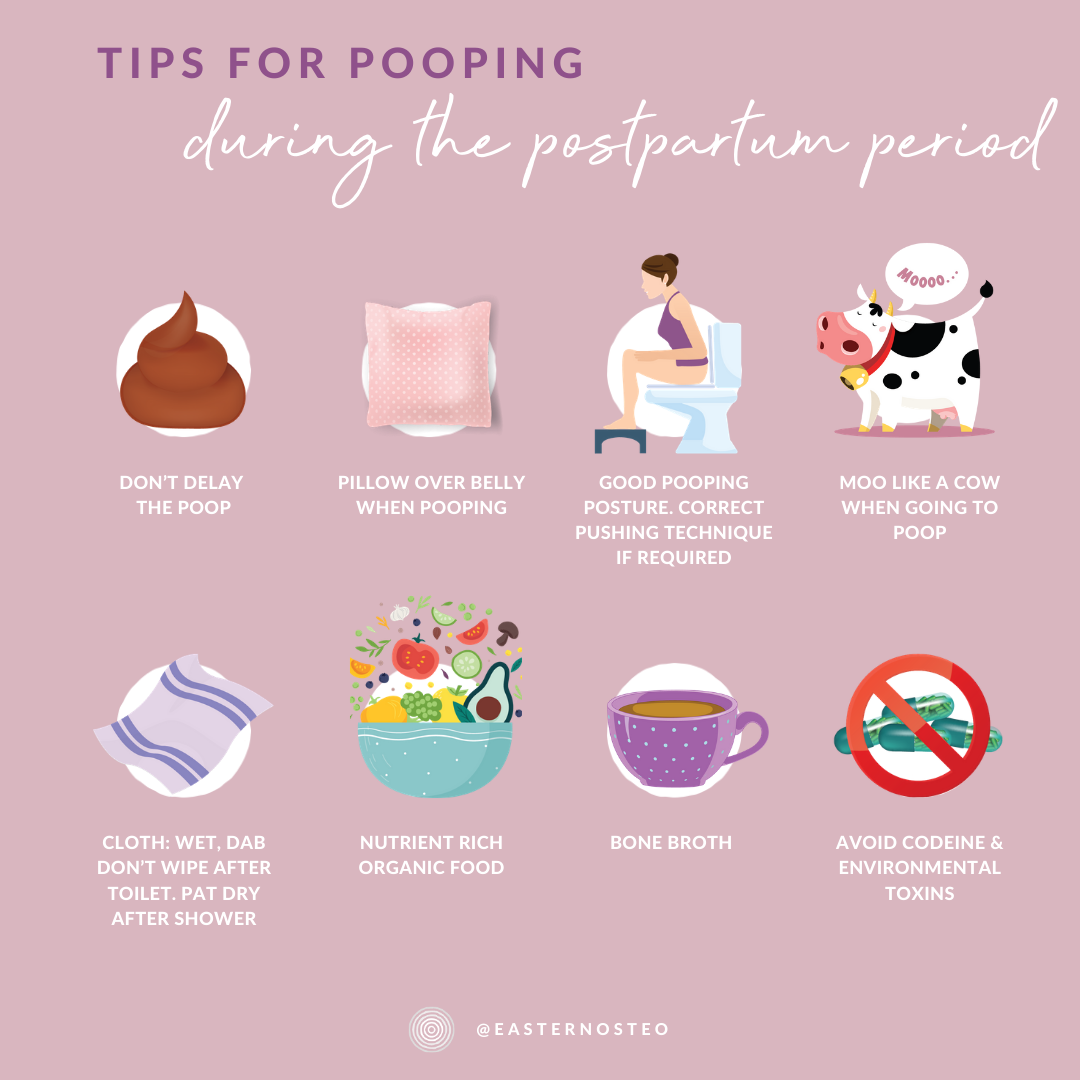
Kate's Tips for Pooping in the Postpartum Period

Now let me tell you something I found out the hard way… NO ONE tells you that having a vaginal birth can feel like the baby is coming out of your bum. Anyone with me??

Postnatally, there are lots of conversations about looking after your vagina; regarding tissue tearing, episiotomy and surgical repairs. Today however, we are doing a 180 and talking about the rectum, and, you guessed it... poop. It certainly makes sense that this area might be tender, and if you have had the privilege of seeing a vaginal birth in person or via photos or video, you can see how the rectum has been pulled and stretched away from its usual position. As unpleasant as this may sound, we do actually need for this to occur, as it helps make room for the little (or in my case - not so little) one, to exit. 

Personally, I had more pain rectally after giving birth than I did vaginally. I actually had no redness, swelling or stitches associated with my magic vagina, but did I have rectal pain? HELL YES! And let me tell you, I was more than a little scared to go poop. However, I knew that prolonging the act was definitely not going to help in the long term. 

Tips for Pooping Postpartum 1.PNG
Tips for Pooping Postpartum 2.PNG

So today I'm giving you my top tips for pooping directly after you give birth. 

  • This is a biggy.. please don’t delay the poop! It might seem scary, but the longer you wait and the more you suppress the urge to eliminate waste, the more backed up you will get. As the stool backs up, it ends up being stored in the descending colon, and in doing so water is removed from your poop making it harder and harder. This will make it more painful and even harder to pass. If you feel the urge, please be brave and poop. 

  • When it's time to go, remember to use the squatty potty. The posture the squatty potty encourages helps to relax the pelvic floor muscle (puborectalis), which straightens your back passage and allows poop to exit with ease. Adding a low tone sound like mooooo, zoooooo or rooooooo can aid in this process by encouraging your abdominal muscles and diaphragm to contract, increasing the pressure around the rectum and stimulating the parasympathetic nervous system.

  • Still nervous about doing a poop? Take a small pillow with you, placing it on your lower belly (this is even more important if you’ve had a cesarean section) and adding some pressure. The act of pooping requires tension (intra abdominal pressure IAP) to be created by our diaphragm and abdominal muscles , the pressure from the pillow can help regulate the IAP normally created by our stomach muscles. Plus it takes pressure off your fresh scar. 

  • A great way of stimulating the parasympathetic and dampening the sympathetic nervous system is with relaxed diaphragmatic breathing. If you are not sure how to do this, check out this video. When we stimulate our parasympathetic nervous system, it gets our digestive system moving and stimulates our rectum to contract while inhibiting our internal anal sphincter, i.e. the back passage opens. The parasympathetic nervous system is all about rest and digest. This type of breathing will also massage the bowel with the rhythmic motion of your breath. Plus, as a bonus, diaphragmatic breathing will also start building an awareness of your breath and pelvic floor muscles. Did you know that when contracting your pelvic floor muscles you increase blood flow to the area which also aids in healing and recovery?

  • As I’m sure you know, things can be a little tender downstairs after a vaginal birth. If you can handle the pain after giving birth, try to avoid medication containing codeine, as it will clog you up even more. There are other alternatives such as panadol for pain relief, and the use of ice to numb the area. Using ice as a cold compress also aids in your recovery by adding compression to your first aid steps. 

  • If you are having trouble with passing stool and need help with softening the waste, magnesium oxide can be a great way to achieve this. However, before taking magnesium please consult with your maternity health team. 

  • Your first meal after giving birth should be nutrient rich and easy to digest. Why hello Bone broth, this yummy nourishing substance can be a great way to keep you hydrated during the labour, plus it will help to give you loads of energy (trust me when I say you will need it) during the birth, and again once you have your new bubba in your arms. This liquid gold is rich in collagen (did I mention collagen can help repair any tissue damage during the labour), gelatin and lots of minerals which are thought to have many medicinal properties, one of which is strengthening the gut lining and improving our immune system. YAY! This is exactly why people offer to cook chicken soup when we are sick. When I say cook I don't mean reheat from a can. I mean the type of soup our nannas cooked when we were young. Not sure on how to cook a bone broth? Check out Chloe’s blog. You can consume the bone broth on it’s own or use it as a base for your yummy soup.

  • Look after your gut MICROBIOME - these are the bugs that live in our gut - with the greatest concentration being in our large bowel, they are very much involved with the health and function of the bowel, and the quality and ease of our poop! Pregnancy and birth interventions can cause lots of disruptions to our microbiome, so it’s important to support and rebalance the microbiome postnatally (in fact it’s super important to optimise it the whole way through pregnancy learn more about that here.

  • We need both PRE & PRObiotics to restore & maintain our microbiome - this can get confusing - let me explain; PREbiotics feed the good bugs and PRObiotics are the good bugs. PREbiotics are found food in plant foods (a rich and diverse plant-based diet creates a rich and diverse gut microbiome) and PRObiotics are found in fermented foods and drinks (yoghurt, kefir, kombucha, sauerkraut etc) or supplements can be used. 

Supplemental PRObiotics are amazing to use postnatally for gut health. They help with motility, reducing inflammation, repairing tissue, regulating stool composition (keeping them soft!) etc. BUT (and this is a big but!) not all probiotics are created equal, you need to consider specific strains, mechanism of action (what they do in the body) and also quality of manufacture. We recommend Qiara - it has lots of great research, many of the beneficial mechanisms of action and it’s a quality Australian made product, it’s actually a breastmilk strain (meaning it was originally isolated from healthy human breast milk). As well as having many proven benefits for gut health and the gut microbiome - it also helps breast milk microbiome, breastfeeding outcomes and infant gut, microbiome & immune development. As far as PRObiotics go - it’s one of the best. I wish every mum and baby could have it. 

  • When choosing food from a menu in a hospital, or if you have a friend or family member who has organised a food roster (these can be the best!), just remember to be fussy and ask for nutrient rich, organic whole foods that rot and make up the colours of the rainbow. Having a 1kg tray of lasagne delivered to your door, as yummy as it sounds, may not be the best for your digestive system. Chicken soup with a side order of sauerkraut can be an awesome request.

  • Most importantly, when eating, take your time to chew, chew, chew your food. Chewing breaks our food down and promotes the production of gastric enzymes. Gastric enzymes are responsible for breaking our food down to an appropriate size for the small intestine to start removing nutrients. The act of chewing, filling our stomach and dumping into the small intestine stimulates a nerve pathway that causes our colon, and it’s natural peristaltic motion, to start. This peristalsis gently propels our stool through the large intestine. Way to go chewing, filling and dumping (pun intended)!

  • Water, water, water! Always have a water bottle on hand and take it everywhere. Being hydrated is absolutely essential if you plan to breastfeed. It is vital to be hydrated for the production of your milk. Did you also know that dehydration can be a major cause of constipation? Since you are taking your bottle everywhere, when you have had a poop or a wee, rather than wiping the area with dry toilet paper, try using a soft damp cloth, especially if you have stitches, hemorrhoids or fissures.

  • Whether you have, small graze or a minor perineal tear, an epsiotomy or a larger tear involving the external anal sphincter; it’s likely your perineal area ( the space between your vagina and anus) will be tender and need some ice and compression for 24-48hrs. Keep the area dry and clean. When drying after a shower, remember to dab the area dry. 

  • Sleep. When you can, get some sleep. Hahaha… I know that this idea is good in theory but quite hard to achieve in practice. However, it is super important that you look after yourself and get sleep when you can. Try to limit screen time - especially at the 2 am feed... as tempting as it is to pick up your phone, DON’T! The blue light can affect your melatonin levels, therefore making it much harder to go back to sleep. 

  • Move. This may seem like a hard task, but starting with small walks like checking the mail can be a great way to stimulate your GUT to get moving. 

At Eastern Osteopathy we believe that having good quality poop and optimising your gastrointestinal tract (GIT) health should be part of all new mamas postnatal health plans. Doing so will not just have a positive impact on your git, it will have a positive impact on your immune system, your mental health, the function of your pelvic floor and then there are the health benefits to your new baby. 

4 reasons why all women should have a postnatal check up

Dr Kathryn Johns

Giving birth can involve lots of tears, love, fear, gratitude and a little bit of OMG! The transition to parenting is a time of discovery and working out your new life as a mother or father of one (two, three or more)! There is so much emphasis on #selfcare for mothers, but when the new addition arrives mama tends not to come first or second. Selfcare is forgotten or put to the bottom of the ‘things to do’ list.

At Eastern Osteopathy we believe there is no better time than postnatally to embrace the self care message, and look after you. For postnatal mothers, we offer postnatal appointments with our women’s health osteopaths. Aside from self care, here are the four main reasons why we believe you should put mama first, and make an appointment.

Treatment.jpg

1. Change

In the hours to days after giving birth your entire body goes through rapid anatomical changes; in particular the anterior abdominal wall (the front of your stomach/belly region) and the pelvic floor. These two areas make up a major component of your core canister.

Your sleep (if any) will be interrupted. You will be tired (aka exhausted) and spending your time breastfeeding (or bottle feeding, or expressing, or both), carrying, cuddling, settling, all while your body is adjusting to its new posture without the support of a strong core. At Eastern osteopathy we encourage all new mamas to make an appointment in the weeks following the birth of their little one to make sure their bodies are in alignment, and moving correctly. When this is achieved we place less stress and strain on our muscles and joints, creating an environment optimum for healing.

2. Pelvic floor

Pregnancy, and giving birth vaginally places huge stress on your body; in particular your pelvic floor muscles (PFMs). It is estimated that during a vaginal birth the PFMs stretch up to 3.5 times their normal length, (WOW!) allowing your little one to pass through your vaginal canal. For some women, to aid in this process, tearing of the perineum or an episiotomy may be required. It’s no surprise it can take some time for these muscles to recover and heal.

Pelvic floor dysfunction can look different for everyone. We find many of our patients only associate accidental leakage with PFD. For many people, this is not the case. PFD can present with a variety of symptoms ranging from, but not limited to, incontinence of urine or faeces, urgency and frequency of urination to constipation or pelvic girdle pain. Not sure if you have an issue with your pelvic floor? Take our short questionnaire here.

At Eastern Osteopathy, we don’t believe you should wait for pelvic floor symptoms to present before seeking postnatal osteopathic care. Being proactive about your health with osteopathic treatment, and getting an appropriate rehabilitation program, involving movement practices, breathing exercises and pelvic floor strengthening, or relaxation techniques is essential after pregnancy.

Both myself (Dr. Kathryn Johns - osteopath) and Dr. Elizabeth Johns - osteopath have completed further training in the assessment, retraining and rehabilitation of the pelvic floor; using both internal and external techniques.

We have also been trained in the use of a Real Time Ultrasound to diagnose pelvic floor and deep abdominal dysfunction. The RTU machine allows Elizabeth and myself to assess your pelvic floor without the need for an internal assessment.

When assessing your pelvic floor, we don’t just assess its function (i.e. how strong it is, and how many kegals you should do), we also look at your body as a whole to see if there are any biomechanical issues that could be impacting on how well your pelvic floor functions.

For more information check out our blog on What to expect from a women’s pelvic health assessment.

3. Diastasis Recti Abdominal (DRA) abdominal separation

During pregnancy DRA is a normal, natural process which allows your body to stretch and change as your little one grows. Research has estimated that by 35 weeks gestation, 100% of soon to be mamas have DRA and by 12 weeks postpartum just under 40% of new mamas will have a DRA. (1) If at 8 weeks postpartum you have a DRA, studies have shown that without intervention, you will still have a separation 12 months after giving birth. (2)

Assessment of the DRA is not about the size of the gap, what we will be looking for is the ability to create tension across the gap (anatomically known as the linea alba). Creating tension in the Linea alba is achieved by correct contraction of the core muscles. If you are unable to create tension, we will endeavour to work out why. Is it due to whole body alignment impacting on the function of your deep core? Or do you need to learn to reconnect and strengthen your deep core?

During your appointment you will be taught how to assess and monitor your ability to generate tension within the linea alba, as to determine when an exercise is appropriate for you.

For more information see Diastasis Recti on our website

4. Pain 

For many mamas to be, pregnancy pelvic girdle pain (PPGP) is reality and for most of these ladies, giving birth resolves the symptoms of their PPGP! For some women, it’s not that simple. 1 in 10 women with PPGP are still suffering with chronic and severe PGP up to 11 years after giving birth (3).

Giving birth, feeding, carrying and settling your young babe can result in a variety of new complaints including, but not limited to, the following:

  • Lower back and pelvis pain

  • Pelvic girdle and pubic symphysis pain

  • Mid back pain during and after breastfeeding

  • Neck pain and headaches 

  • Wrist pain

As osteopaths, the emphasis of our treatment is on the whole person and not solely on their symptoms. We use a variety of techniques to gently release any strains present; relieve pain, discomfort and improve mobility to support the body’s ability to heal.

A common question we regularly get asked by our pregnant patients is: How soon after giving birth can I have treatment? If you are in pain, you can receive treatment within hours.

Nine months ago I gave birth to my second daughter. Hours later I could barely sit due to coccyx pain, making breastfeeding near impossible. Lucky for me, I have a twin sister who is an osteopath (and my business partner, aka Liz) Less than 12 hours after giving birth I had an osteopathic treatment. The relief soon followed and shortly after, I was able to breastfeed and care for my daughter in comfort.

◦◦◦◦◦

At Eastern Osteopathy we see postnatal women at all stages, from those who have been mamas for only a couple of days to mamas who are now grandmothers, and have been putting up with their symptoms for a couple decades. We believe it’s never too late to start looking after yourself and putting mama first! 

Regardless of your concerns during your postnatal check up; as osteopaths, we look at your body as a whole and create an individualised treatment plan, addressing any areas in your body (joints, ligaments, fascia and muscles), movement patterns, dysfunctional postural or breathing patterns that may be impacting on your overall health. 

The treatment will include a physical treatment, lifestyle advice and a specific rehabilitation program to support your treatment outcomes. Generally these programs will include movement practices, breathing exercises and pelvic floor strengthening or relaxation techniques.

To book your postnatal appointment: book online here or call us on 9042 0407.

Want to know more? Call the clinic on 9042 0407 to speak with us today.

References

  1. Moto P G, Pascoal A G, Carita A I, Bo K 2014 - prevalance and risk factors of diastasis recti abdominis from late pregnancy to 6 months postpartum, and relationship with lumbo-pelvic pain. Man Ther 2014

  2. Coldron Y, Stokes M J, Newham D J, et al 2008 - postpartum characteristics of rectus abdominis on ultrasound imaging. Manual therapy 13: 112

  3. Elden, H et al (2016). BMC Musculoskeletal Disorders, 17(1), 276.